Breaking News

iTruth.us Pages
January 1, 2025
Popular News
iTruth.us Pages
January 1, 2025

Enter your email address below and subscribe to our newsletter

Reflections on My Beliefs, Moral Governance, and Daily Life
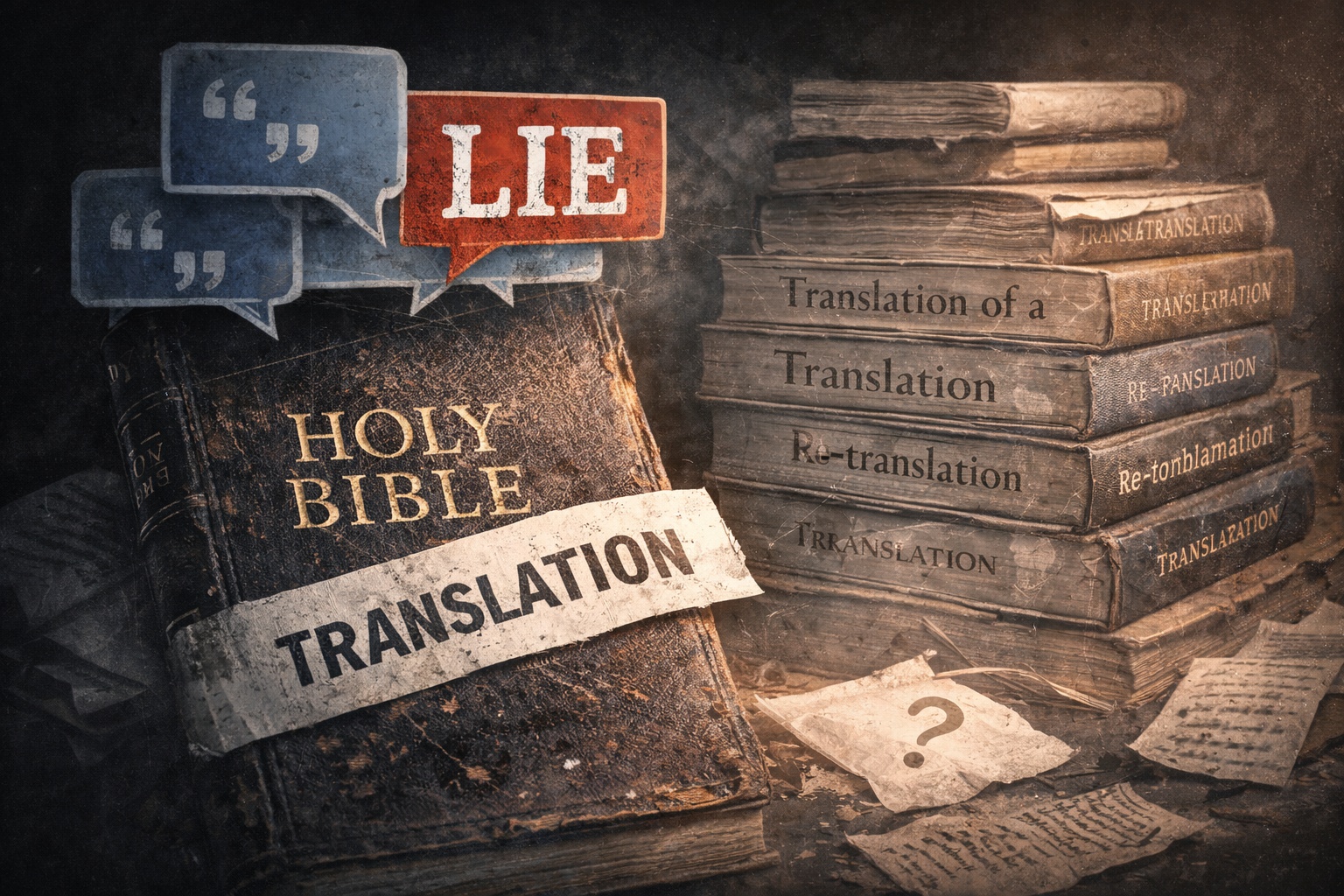
Every few weeks, some self-proclaimed intellectual on social media pops up to smugly declare, “The Bible is just a translation of a translation of a translation!” — as though they’ve just cracked the Da Vinci Code and revealed a grand conspiracy the rest of us simpletons somehow missed.
Let me spare you the suspense: that claim is complete and utter nonsense.
For over a century now — and especially today — Bible translations have come straight from the original languages themselves. Not from the King James. Not from the Latin Vulgate. Not from some mysterious game of telephone passed down through medieval monks. The modern Bible in your hands is a direct translation from Hebrew (Old Testament) and Greek (New Testament) — the very tongues in which it was written thousands of years ago.
When translators produce a modern Bible, they don’t use other translations as a base. They start with the same languages the original authors wrote in:
Old Testament → translated directly from ancient Hebrew (with a touch of Aramaic).
From the American Standard Version (1901) to today’s ESV, NASB, CSB, NKJV, NIV, and beyond — every single one is a fresh translation from the original manuscripts. No middlemen, no translation chains, and no “telephone game.”
New Testament → translated directly from Koine Greek, the common Greek spoken in the first century.
The same Hebrew Masoretic Text and the same Greek New Testament sources (Nestle-Aland / UBS) form the foundation. Every word is studied in its linguistic, cultural, and grammatical context. The result? Direct translation from original language to your language.
If the Bible were really an ever-mutating game of copies and reinterpretations, the evidence would show it. It doesn’t.
When archaeologists uncovered the Dead Sea Scrolls in the 1940s — manuscripts over a thousand years older than any we had at the time — critics gleefully expected massive contradictions. Surely these ancient scrolls would show how much the text had changed, right?
Wrong.
When scholars compared those scrolls to the modern Hebrew Bible, they found them virtually identical — down to minor spelling differences that didn’t affect meaning in the slightest. A millennium of copying, and the message remained intact.
No other ancient text in the world can boast that kind of preservation.
This is where the argument collapses completely.
Let’s look at the numbers:
Work Approximate Copies Earliest Copy Gap Accuracy Confidence
Plato’s Dialogues 7 ~1,200 years High (for philosophy)
Aristotle’s Works 49 ~1,400 years Moderate
Homer’s Iliad ~1,800 ~500 years Very High
New Testament 25,000+ Within decades Unmatched
No one questions the writings of Plato, yet they exist in only a handful of manuscripts. But when it comes to the Bible — with over 25,000 surviving manuscripts across languages and regions — critics suddenly demand perfection beyond human reach.
Yet the Bible stands tall, verified, cross-checked, and unwavering.
Modern translations don’t drift further from the originals; they draw closer.
Every new archaeological find, every papyrus fragment, every recovered codex helps refine our understanding of what was already astonishingly accurate. The translators of today have access to far more data, computing tools, and manuscript comparisons than any generation before them.
Textual criticism — the discipline of comparing every ancient copy to reconstruct the original — has reached microscopic precision. Footnotes even tell you when a word or phrase differs among manuscripts. No other ancient literature receives this kind of scrutiny.
If the Bible were corrupted, we’d see chaos. Instead, we see consistency — the same divine message ringing through the centuries.
Let’s be clear: the Bible is the most historically verified document on earth.
Every serious translator goes back to the oldest and best manuscripts — not someone’s paraphrase of a paraphrase. The more we dig, the more we find. And every discovery confirms that the Bibles we read today are faithful, accurate, and trustworthy to the originals.
If you’re going to reject Scripture, fine — but don’t insult your own intelligence by pretending it’s because the text has been lost through endless translation. That’s not skepticism. That’s ignorance disguised as sophistication.
So the next time a “progressive thinker” smugly says the Bible is a translation of a translation, kindly ask them to name a single verse that has changed meaning through all these supposed rewrites.
They can’t — because it hasn’t.
The Bible in your hands is the same Word that thundered from the mouths of prophets, apostles, and our Lord Himself. Preserved through persecution, copied with reverence, confirmed by archaeology, and translated directly from the ancient languages so that every generation might hear it afresh.
Not a translation of a translation.
Not a fable passed through centuries of distortion.
But the living Word of God — proven, preserved, and powerful.
Peter Vidrine
✝️ Standing for Truth in an Age of Deception
📖 itruth.us/