
Newsletter Subscribe
Enter your email address below and subscribe to our newsletter

Enter your email address below and subscribe to our newsletter
Reflections on My Beliefs, Moral Governance, and Daily Life
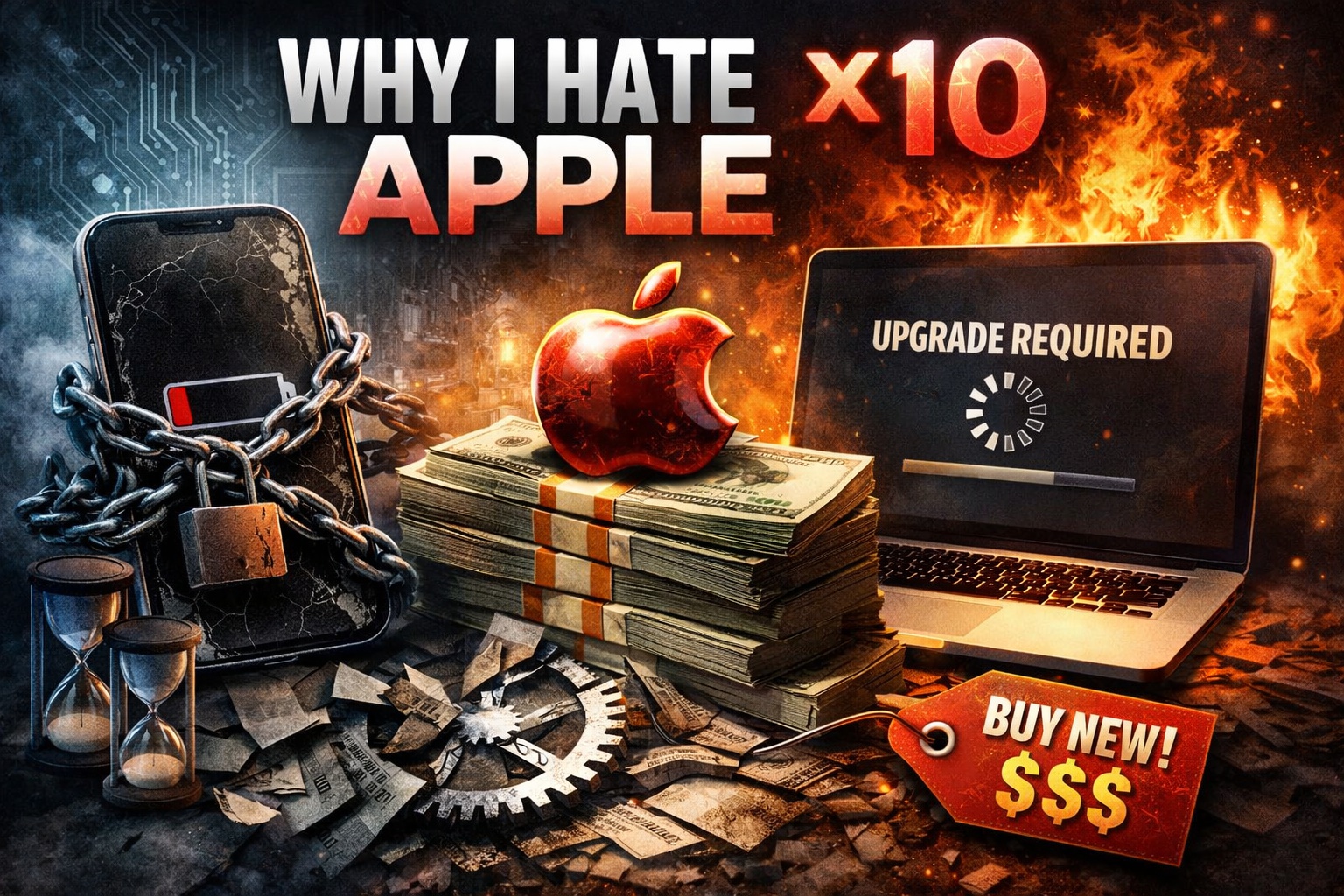
Let me get this out of the way right up front so nobody accuses me of being a fanboy for the other side: I do not like Microsoft. I’ve spent decades dealing with their half-baked updates, UI whiplash, forced reboots, and their uncanny ability to fix one thing while breaking three others. I’ve cursed Windows more times than I can count.
And yet—somehow—Apple still manages to be worse. Exponentially worse. Not accidentally. Not clumsily. But deliberately, methodically, and profitably.
If Microsoft treats users like an inconvenience, Apple treats them like a renewable revenue stream that needs to be harvested on a predictable schedule.
Apple absolutely believes you’re not technical enough to know what’s best for you. That part is obvious. It’s baked into the UI, the locked-down settings, the patronizing explanations, and the relentless removal of user choice “for your own good.”
But the real problem isn’t arrogance.
The real problem is financial exploitation through engineered obsolescence.
Apple doesn’t merely allow your hardware to age out.
They actively march it toward irrelevance—one update, one policy change, one “security improvement” at a time.
Your iPhone doesn’t suddenly become slow by accident. Your iPad doesn’t suddenly lose features because it’s tired. Your Mac doesn’t suddenly stop being “supported” because physics intervened.
It happens because Apple decided—on a spreadsheet—that it was time.
Apple has perfected something far more insidious than planned obsolescence.
They’ve figured out how to rent you hardware while letting you believe you bought it.
You pay full price:
But ownership ends the moment Apple says so.
The second Apple:
…your perfectly functional device is financially devalued on purpose.
You didn’t break it. Nothing is wrong with it.
Apple just pulled the rug out from under you.
That’s not ownership. That’s a lease with no contract and no disclosure.
Apple doesn’t usually nuke your device in one dramatic update. That would cause backlash.
Instead, they do it surgically:
You’re told:
“Your device is just old.”
No. It’s made old.
The hardware didn’t fail. The policies did.
And the fix is always the same:
“Upgrade.”
If you want proof that Apple doesn’t care about long-term ownership, look no further than their CPU history.
Apple has switched Mac CPU architectures like a kid changing outfits:
Each transition:
Backward compatibility? Minimal. Forward compatibility? Often nonexistent.
When Apple moves on, you are collateral damage.
Contrast that with Intel’s x86 platform, which—love it or hate it—has maintained astonishing backward and forward compatibility for decades.
You can still:
Apple doesn’t want that.
Apple wants sealed boxes, soldered RAM, glued batteries, proprietary storage, and zero escape routes.
Here’s the part Apple fans really hate hearing.
There are still people—right now—running:
And those machines:
Microsoft may nag, but they rarely reach back in time and disable functionality on hardware you already own.
You can:
In other words: you retain agency.
Apple hates agency.
Apple loves to justify forced obsolescence with the magic word:
“Security.”
But here’s the trick:
Security updates don’t require killing hardware. They require maintaining software.
Apple chooses not to.
Because long-term support doesn’t sell new devices.
And Apple is not a hardware company. They are a lifecycle monetization company.
This isn’t about brand preference.
It’s about precedent.
If companies can:
…then ownership becomes an illusion everywhere.
Apple just happens to be the most successful—and shameless—at it.
Microsoft is clumsy. Microsoft is frustrating. Microsoft makes bad decisions.
But Microsoft doesn’t pretend your computer is a lifestyle subscription disguised as aluminum and glass.
Apple does.
So yes.
I hate Microsoft.
But I hate Apple to the power of 10—because they smile while they do it, and convince millions of people to thank them for the privilege of being slowly, quietly, and expensively pushed out of hardware they already paid for.
And that’s not innovation.
That’s exploitation with a logo.

The Chinese Dragon Is Choking on Its Own Smoke